


 Calendar
 +421 949 218 601
New Courses

P3.express is a minimalist, practical project management system. It’s easy to learn, use and teach. P3.express is open and free, with a Creative Commons license. It comes with the option of international certification, valid for life.
DevOps Fundamentals is the starting point for anyone involved in an Agile and/or DevOps team. With international certification valid for life.
Extends the skills of any professional in a DevOps environment to help team members and other stakeholders in the organization apply DevOps concepts and principles within their organization.
Would you like to prepare for the P3.express Practitioner online exam yourself without taking a course?
Would you like to order the online P3.express Practitioner international certification exam only?
You can purchase the exam itself without the course from us.
Most popular courses
-
P3.express is a minimalist, practical project management system. It’s easy to learn, use and teach. P3.express is open and free, with a Creative Commons license. It comes with the option of international certification, valid for life.
 Enter the world of agile frameworks, approaches, techniques and behaviours.
 Gain advanced knowledge of Agile needed for Scrum Master & Product Owner roles and prepare for international certification.
Why us?
Guaranteed dates
& other guarantees

Profit from our unique set of guarantees: quality, date, best price, know-how retention and fair play.
Experienced trainers
We use trainers with real life experience, who use themselves what they teach. Their average experience is over 20 years. Of course, they are all qualified trainers and hold all necessary accreditations & certificates. They are able to deliver training in English, German, Czech and Slovak.


References






"Thank you. I received what I needed and expected. In spite of intensity of the course everything was OK, manageable."
Kristýna Korbelová, Project Manager
"The course presented an integral perspective of methodics of PRINCE 2. It was well prepared and delivered. I recommend it."
Gabriela Hynková, Project Manager
“I definitely recommend your courses to others. For me, not only the theoretical level was great, but also connection to pratical examples from real projects thanks to expirienced trainer.“
Petr Turovský, Project manager
"I liked the most practical examples and group exercises. I was satisfied with the trainer and the refreshments. You have quiet and representative premises. I chose you because of quality and know-how guarantee, too. I will be happy to recommend you."
Tomáš Daníček, PMO Leader, Project Manager
"Excellent targeted approach. I liked the most the PRINCE2 themes and minimum requirements. Great trainer. A really good approach, experience. I was satisfied with the training venue and refreshments, too. I would always recommend you."
Peter Borák, Partner Advisory Services, Central Cluster Advisory Cybersecurity Leader, Ernst & Young
“I enjoyed case studies and sharing working experience of the speaker. You have enough experience and I appreciate your friendly approach. I would recommend your course to others.”
Zuzana Dubovská, Senior Consultant, Ernst & Young
“You have great time management, experience and deep knowledge. The most I liked the case study. I was fully satisfied with our trainer.”
Matej Bosnak, Country Managing Parter, Ernst & Young
“I really appreciated the coaching skill and Stefan’s quick responses to our questions. The most I liked the exercises, we learned how to approach/ to use specific themes.”
Daniel Vranješ, Ernst & Young
"Stefan, thank you for the information (that I have passed the PRINCE2 Practitioner exam) and professional preparation. From now on I'll be just sitting under the framed certificate and doing project management consulting... :-)"
Miroslav Bedlek, Head of Delivery Management, Gratex International
"I liked the case studies and exercises the most. Really good training, knowledge transfer and really good organisation of course. I recomend you."
Tomáš Fabčín, Junior Account Manager, Gratex International
"I liked the practical exercises the most. Really good preparation, training, trainer - super! I recommend you."
Viera Rozborilová, Head of Project Back Office, Gratex International
"I liked the exercises, real examples and explanations. Stefan Ondek is a very good trainer. You teach really well. I recommend."
Jozef Kozar, delivery manager, Gratex International
"Very well organized training supported by examples from real life experience. PRINCE2 is a very good certification for a project manager and the way of teaching/guidance in the POTIFOB company is very effective. I truly recommend it."
Lydia Handzová, Project Manager, IBM
"I liked the most the following: practical exercises, discussion. The course had a sufficient scope and manner, I would not change it."
Oľga Pašmíková, Project Manager, IBM
"I liked the most the following: the sequence of theoretical preparation, verification questions and applied exercises + possibility of utilization of e-learning, maintenance of a logical flow of information and their sequential application in exercises. Templates of management products accessible online in the e-learning are very useful."
PRINCE2 certificate training attendee, IBM
"The most I liked the trial test. I was satisfied with the trainer, training venue and given refreshment. I recommend!"
Jiří Horník, PMP, Project Manager, IBM
"I liked the case studies and examples from practice during training. The course is led by experienced professionals. I recommend."
Tomáš Dokulil, IT business consultant ERP, Konica Minolta
"I really liked the group exercises and repeating discussed topics each day. I appreciate sending study materials in advance of the training. Really good intensive lectures, practice tests each day. The course was intense and well organized."
PRINCE2 Foundation course participant, Konica Minolta
"Most of all I liked group tasks and the subsequent discussion regarding our projects."
Jan Kolář, Konica Minolta
"I really liked the test, I was very satisfied with the trainer, Coneo training rooms in Brno and refreshments during training."
Jiří Adamec, Konica Minolta
"I liked the most case studies because it was the best way how to understand the topic. I appreciate covering whole topic in short time."
Petr Bulíř, T-Mobile Czech Republic
"I liked working in teams "in practice". Slides are good. Especially inputs + outputs + tools, summary slides. I recommend this course. I also attended this course upon recommendation."
Tomáš Pospíšil, designer and release manager, T-Mobile
"I liked the practical 'cases'. Very good and experienced trainer."
Michal Anděl, designer and release manager, T-Mobile
"I would recommend courses for others. I enjoyed theory interpretation and also trainer´s experience with Agile from practice. I was satisfied with the training venue."
Jan Středa, Programmer – Analyst, T-Mobile
Blog
All Articles
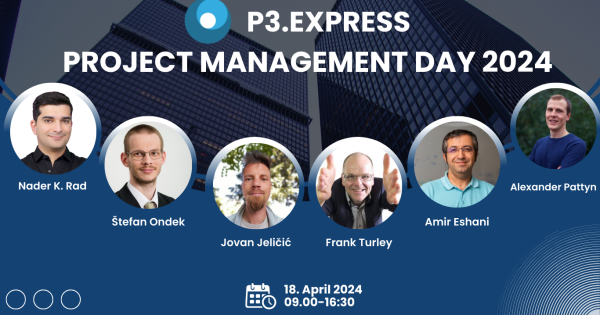
On 18.4.2024 we held an event about the mininalist, free project management system P3.express and its related modules.
- Read more about P3.express Project Management Day 2024
- Log in to post comments
The continuing increase in the prices of the most well-known international project management certifications, the costs of their maintenance, as well as the complexity of some of the standards on which they are built, leads customers to look for simpler and more affordable solutions.
Are you among them? Meet P3.express!

Get the basics of DevOps in the latest version 3.0 and the advanced knowledge and skills needed for leaders and coaches. To get acquainted, we invite you to the free global online conference DASA Connect 2023.
- Read more about New DevOps Courses with DASA Accreditation
- Log in to post comments